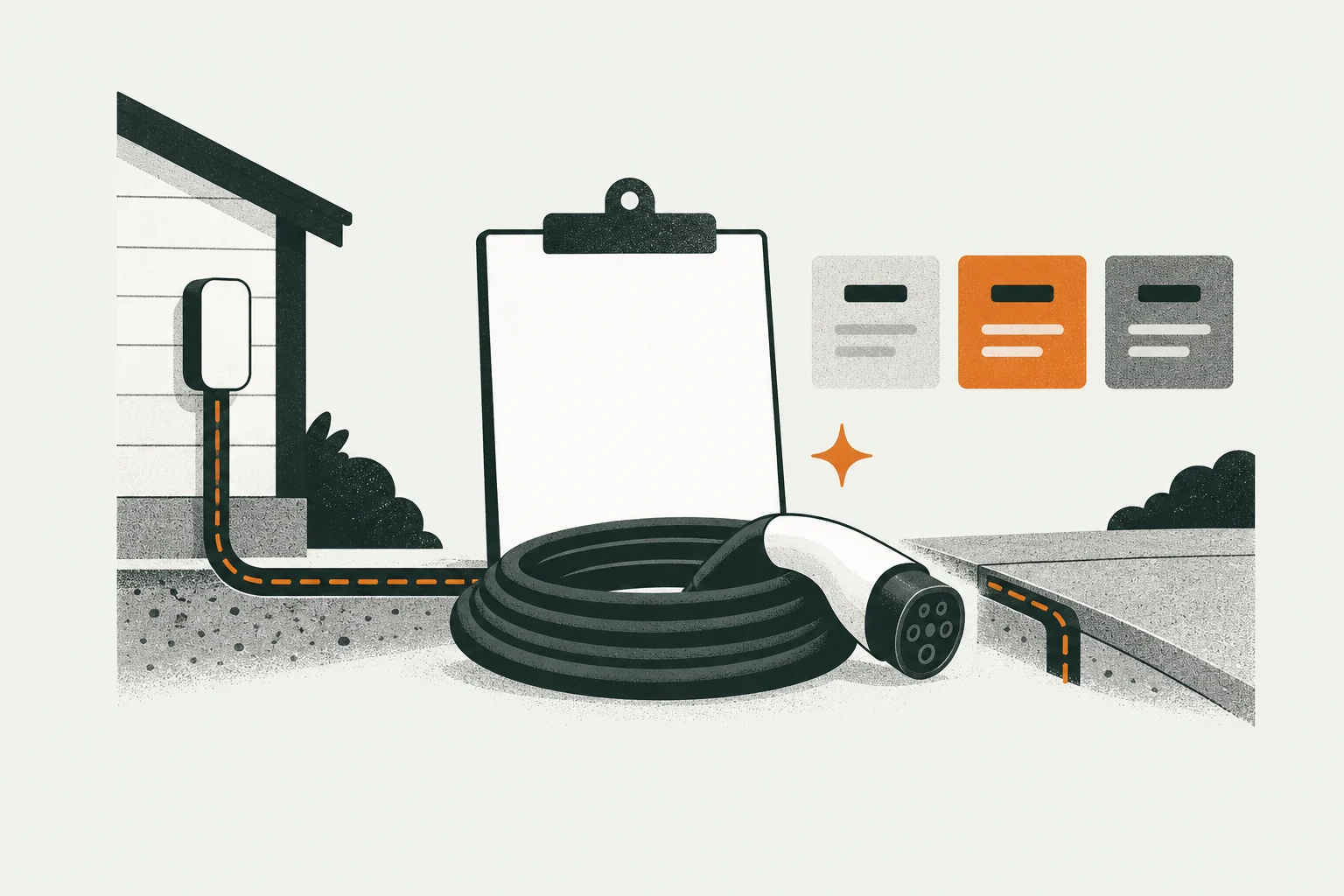
The most useful answer to “What does a Level 2 EV charger installation cost?” is not one national average. It is a scope: charger, circuit, route, capacity work, permit, and finish work for one property.
For early planning, the EPA currently shows $400–$1,000 for equipment and $300–$2,000 for installation. Qmerit reports a wider 2026 installer dataset: $749–$2,500 in its installation dataset, averaging $1,700. Neither range includes every panel, service, trenching, or repair scenario.
Use those figures to set a starting budget. Use a site-specific quote to make the decision.
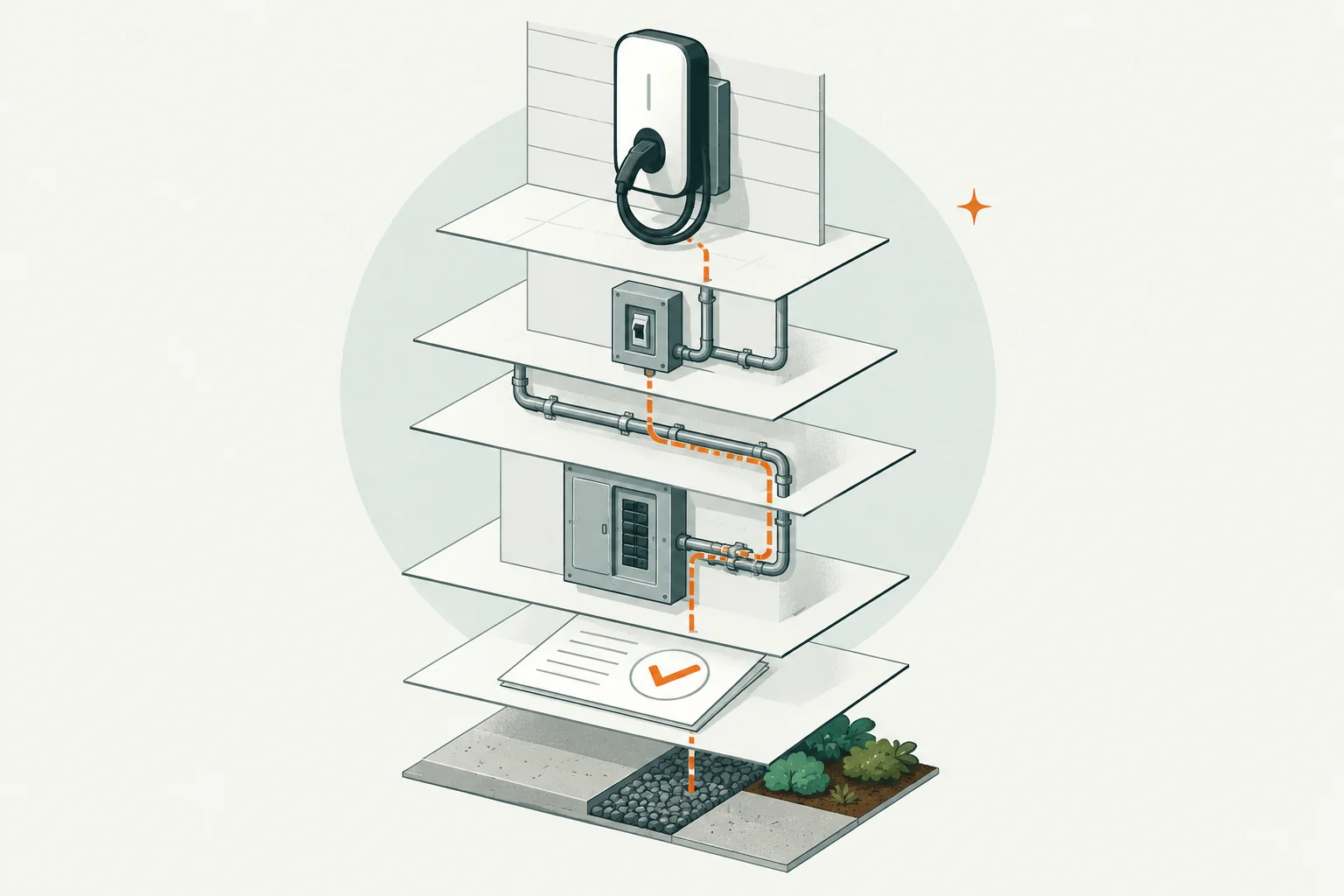
A Level 2 cost estimate has six layers
| Layer | Common items | What makes it move |
|---|---|---|
| Charger | EVSE, connector, cable, wall mount | Current, controls, enclosure, warranty |
| Branch circuit | Breaker, conductors, conduit, boxes | Amperage, length, material, route |
| Connection | Hardwire or listed receptacle setup | Device, enclosure, ground-fault requirements |
| Capacity | Calculation, energy management, panel/service work | Existing and future household loads |
| Approval | Permit, plan review, inspection, utility steps | Local process and corrections |
| Finish work | Trenching, patching, firestopping, bollards | Surface and site conditions |
A quote that collapses these layers into “install charger” is hard to compare and easy to misunderstand.
2026 planning ranges—and their limits
The EPA's $300–$2,000 installation range is useful for a straightforward new circuit, while its $400–$1,000 equipment range covers many consumer wall chargers. The agency also notes that higher current, longer distance, difficult locations, and electrical upgrades increase cost.
The ENERGY STAR electric-ready guide discusses preparation for new electrical loads. Use site-specific proposals for panel, service and control costs. National planning ranges are not bids for your city. Labor rates, adopted code, equipment, permits, utility construction, and finish work vary widely.
Three budget scenarios
Short, capacity-ready route. The panel has documented capacity, the mounting point is nearby, the route is accessible, and no unusual finish work is needed. This is the type of project most likely to fit a standard-installation range.
Long or difficult route. The circuit crosses finished space, runs outdoors, reaches a detached garage, or requires trenching. Material and labor increase even when the panel has capacity.
Capacity or service project. The job includes energy management, panel replacement, service equipment, utility coordination, or substantial repair. At that point, the charger circuit is one part of a larger electrical project and should be scoped separately.
The charger price is not the installed price
Two chargers with the same advertised current can produce different installation costs. One may be hardwired only, another may offer a plug; one may include a long cable, another may need a different location; one may support a listed load-management accessory, another may not.
Do not buy from amperage alone. Confirm:
- vehicle connector and charging limit;
- hardwired or manufacturer-approved plug-in configuration;
- indoor/outdoor rating;
- adjustable-current and commissioning requirements;
- utility-program eligibility;
- independent safety listing for the exact model;
- warranty and service path.
The best Level 2 charger by installation scenario guide applies those filters without claiming a one-size-fits-all winner.
Circuit distance matters, but route difficulty matters more
Quotes often price a defined route length. Ask where the measurement starts and ends, what happens above the allowance, and which wiring method the price assumes.
A surface-mounted garage run can be easier than a shorter route through finished rooms. A detached structure may add trenching, exterior-rated materials, existing feeder questions, and restoration. Concrete, landscaping, fire-rated walls, tight crawlspaces, and charger impact protection can all affect scope.
Give each contractor the same photos and target location. If one proposes a different route, ask them to mark it and explain the tradeoff.
Panel capacity is not the same as an empty slot
An electrician should evaluate the home's load under the adopted code. A spare breaker position does not prove available capacity, and a full panel does not prove that utility service replacement is necessary.
When a quote adds a panel or service upgrade, ask for the capacity basis and the alternatives considered. Depending on the site and local acceptance, alternatives may include a lower charger setting or listed load management. Our panel upgrade versus load management guide explains the decision.
Be wary of both extremes: “you definitely need a new service” without supporting work, and “this device guarantees no upgrade” without a site-specific design.
Hardwired and NEMA 14-50 costs are not directly interchangeable
Hardwiring removes the receptacle and plug connection but may require charger-specific termination and commissioning. A NEMA 14-50 installation adds the receptacle, enclosure, and local ground-fault requirements; it must also match the charger's instructions and current limit.
The cheaper line item is not automatically the better lifetime choice. Permanent outdoor charging, higher-current charging, nuisance-tripping risk, portability, and replacement plans can change the answer. Compare the methods in hardwired versus NEMA 14-50.
Normalize every quote before comparing prices
Copy each bid into this worksheet:
| Question | Quote A | Quote B | Quote C |
|---|---|---|---|
| Exact charger/current | |||
| Breaker and circuit rating | |||
| Route and included length | |||
| Wiring/conduit method | |||
| Hardwire or receptacle | |||
| Load calculation included | |||
| Permit/inspection included | |||
| Trenching/patching included | |||
| Panel/service work | |||
| Commissioning and labels | |||
| Labor warranty | |||
| Exclusions/allowances |
If a row is blank, the quotes are not equivalent yet.
Incentives can change net cost, but timing and eligibility control
Check your utility, state energy office, and local government before purchasing equipment. Some programs require an approved model, preauthorization, licensed installation, inspection, data sharing, or enrollment in a managed rate.
Do not subtract the federal Section 30C credit from a new installation estimate. The IRS says the amended credit applied to eligible property placed in service before July 1, 2026.
Ways to control cost without cutting safety scope
- Put the charger where the cable reaches comfortably and the electrical route stays practical.
- Size charging to the actual overnight need rather than the charger's maximum.
- Ask whether approved load management is a valid alternative to capacity work.
- Coordinate the project with other planned electrical upgrades.
- Get written, normalized quotes from appropriately licensed contractors.
- Complete incentive preapproval before buying when the program requires it.
Do not save money by skipping a required permit, using an unidentified receptacle, choosing unlisted equipment, or accepting an undocumented current setting.
Frequently asked questions
Does the installation price include the charger?
Not always. Ask for equipment and labor as separate lines and confirm who handles warranty replacement.
Is a panel upgrade usually required?
No national percentage answers that question for one house. A load calculation, panel condition, breaker space, future loads, and utility constraints determine the valid options.
Is plug-in charging cheaper than hardwiring?
It can be, but a compliant receptacle setup adds hardware and may add ground-fault requirements. Compare complete designs, not one component.
How many quotes should I get?
Enough to compare scope and identify an outlier—often two or three. Use the same site information and requested outcome for each.
Turn the estimate into a decision, not an optimistic total
Use the six-layer worksheet to mark every cost as confirmed, allowance, excluded or unknown. Then put the gross amount you may have to pay beside any conditional incentive. A missing price is not zero, and a potential reimbursement is not cash available for the deposit.
Consider an illustrative comparison: one quote lists $1,200 for its defined work but leaves permit fees and restoration unknown; another lists $1,500 including those items. The first is not yet demonstrably cheaper. Ask both contractors to price the same charging outcome and route, and clarify where a change order could arise. Keep the actual answers in the installer comparison worksheet.
Next separate the installation decision from the electricity bill. A faster wall unit does not automatically reduce the cost of each driving mile. A time-of-use offer may reprice the whole home, and its savings depend on when household as well as EV energy is used. Compare the same annual load under each eligible rate plan before buying equipment solely to chase a cheap overnight headline.
Finally compare the lowest-cost adequate complete arrangement with the proposed upgrade. Suitable existing charging, a professionally accepted lower-current installation or supported management may serve the required departure energy. A damaged panel still needs its own assessment even if lower charging power would fit. The valid saving removes unnecessary scope; it does not remove required approval, protection or inspection.
Keep the decision in a charger project file: accepted scope, assumptions, written exclusions, incentive reservations, installed model, approvals and final settings. That record helps when an apparent low installation price turns into a later support or replacement question.
Get a scope you can defend
Ask each bidder to state the charging current, circuit, route, capacity basis, permit responsibility, commissioning, and exclusions. That makes the final price meaningful.
Commercial disclosure: EV Charging Nation may receive compensation when a reader uses the installation-help call path. The cost ranges and comparison framework remain editorially independent.
For contractor screening, continue to how to choose an EV charger installer.