The right EV charger installer gives you more than a low number. You should receive a defensible capacity conclusion, a defined electrical route, permit responsibility, equipment settings, and a clear handoff after inspection.
This seven-step process works whether you search for an “EV charger installation company,” ask a utility for contractors, or collect local electrician referrals.
Difficulty: Beginner
Estimated time: 60–90 minutes to prepare; site visits vary
Prerequisites: Vehicle/charger requirements, panel and parking photos, property approval if applicable
What you'll need
- Vehicle model, connector, and normal daily mileage
- Panel, parking, and likely route photos taken without opening electrical equipment
- Property or HOA approval requirements, if applicable
- The exact charger manual if equipment has already been selected
- A simple worksheet so every bidder answers the same questions
Quick overview
| Step | Action | Evidence |
|---|---|---|
| 1 | Define the same job for every bidder | One-page project note |
| 2 | Verify legal credentials | License and insurance |
| 3 | Require a capacity assessment | Load-calculation basis |
| 4 | Compare route and method | Written scope |
| 5 | Assign permit responsibility | Permit line item |
| 6 | Check commissioning and support | Handoff checklist |
| 7 | Normalize price and exclusions | Side-by-side worksheet |
Step 1: Define the result before contacting installers
Tell each contractor the same facts: vehicle model, normal daily mileage, parking position, desired cable reach, panel location, current charger model if already purchased, and likely future loads or a second EV.
Include photographs of the panel, the area around it, the proposed charger wall, and the route between them. Do not remove covers or enter unsafe spaces for a photo.
State the outcome rather than dictating an unverified circuit: “I need reliable overnight charging for this driving pattern.” A good installer can compare charging current, capacity, and cost.
Success looks like: every bidder prices the same charging outcome and parking location.
Step 2: Verify the license, insurance, and business identity
Electrical licensing is state or local. Look up the license in the official regulator's database, confirm that it is active and covers the work, and verify the business name on the quote matches the record. Ask for current insurance evidence when appropriate.
“EV certified” can describe useful manufacturer or training programs, but it does not replace the electrical license required in the jurisdiction. ENERGY STAR advises using a licensed electrician to evaluate the home's electrical system.
Ask who will perform the work and who holds the permit. If a platform assigns a local contractor after sale, request that entity's license information before scheduling.
Red flag: pressure to treat the work as a simple appliance hookup that does not need local review.
Step 3: Require an electrical-capacity conclusion
The installer should evaluate the existing service and panel under the code adopted locally. A photograph can support an initial estimate, but it may not be enough for a final capacity determination.
Ask these questions:
- What load-calculation method will be used?
- What charging current does the proposed circuit support?
- Were future electric appliances discussed?
- If capacity is constrained, were a lower current and listed load management considered?
- If a panel or service upgrade is proposed, what finding requires it?
The EPA's homeowner guidance lists a load calculation among the expected electrician tasks. Our panel upgrade versus load management guide helps you evaluate the alternatives without assuming either is always right.
Success looks like: the quote states the charger current and capacity path, not only “50-amp outlet” or “panel upgrade.”
Step 4: Compare the route, materials, and connection method
Walk the likely path from panel to charger. Ask the installer to describe the wiring method, route, included length, wall or ceiling access, trenching, weatherproofing, firestopping, and surface repair.
Confirm whether the charger will be hardwired or plugged into a manufacturer-approved receptacle configuration. The answer affects equipment, current, location, and local ground-fault requirements. Read hardwired versus NEMA 14-50 before choosing.
For outdoor or exposed locations, discuss enclosure rating, cable storage, drainage, mounting, and vehicle impact. For a detached garage, clarify whether an existing feeder is being evaluated or a new route is included.
Red flag: a quote that uses “standard installation” without defining distance, route, current, or exclusions.
Step 5: Put permits and inspection in writing
Ask the local authority having jurisdiction whether a permit is required; do not rely solely on sales copy. Then make the quote say who obtains it, who pays the fee, and who handles inspection corrections related to the contracted work.
If the installer says no permit is needed, ask for the jurisdiction or rule supporting that conclusion. Requirements differ by location and project type.
Keep the permit number and final result with your invoice. They can matter for rebates, insurance questions, a future sale, and later electrical work.
Success looks like: permit ownership is a named task, not an afterthought.
Step 6: Confirm commissioning, labels, and post-install support
The job is not complete when the charger lights up. The installer should set the charger to the circuit's approved current, confirm vehicle charging, explain fault indicators, and leave required labels and documentation.
Ask who will:
- configure the current limit;
- connect the app or local interface if required;
- verify cable reach and holster position;
- register equipment or provide the serial number;
- explain warranty boundaries between labor and product;
- return if the inspector requires a correction.
If a utility rebate or managed-charging program applies, confirm who provides the invoice detail and commissioning evidence it requires.
The U.S. Department of Energy maintains a summary of federal alternative-fuel laws and incentives for initial research.
Red flag: the electrician installs the circuit, another party mounts the charger, and neither owns the final functional test.
Step 7: Normalize quotes before selecting the installer
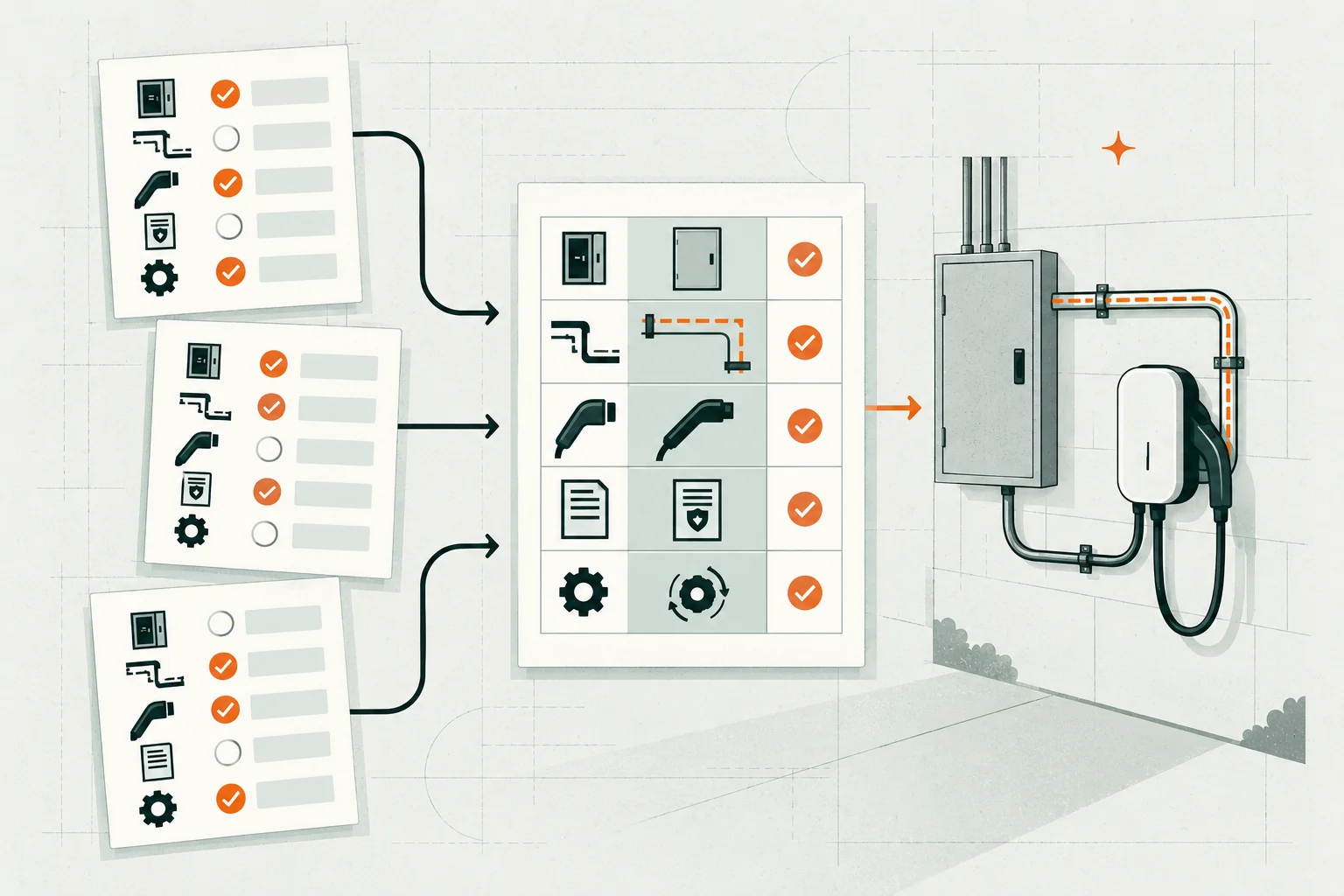
Compare each scope in the same table:
| Scope item | Bid 1 | Bid 2 | Bid 3 |
|---|---|---|---|
| License verified | |||
| Load assessment | |||
| Charger/current | |||
| Circuit/breaker | |||
| Route/length | |||
| Hardwire/receptacle | |||
| Permit/inspection | |||
| Finish work | |||
| Commissioning | |||
| Labor warranty | |||
| Allowances/exclusions |
The lowest complete bid may be a good choice. The lowest incomplete bid is not comparable. For current planning data and cost variables, see the Level 2 installation cost guide.
Common quote problems
The bids specify different charging currents
Ask each installer to restate the price for the same charging outcome or explain why their design differs. A 32 A installation and a 48 A installation are not equivalent.
One bid includes a panel upgrade and another does not
Request the load-calculation basis and inspect whether both considered the same household loads. Do not resolve the disagreement from price alone.
The online price changes after the site review
Compare the original assumptions with the discovered condition. A changed route or capacity need can justify a revision; an undefined “standard” scope makes that harder to assess.
The installer wants you to buy the charger first
Confirm the model, connector, installation method, current, and utility-program eligibility before ordering. The charger should fit the approved design.
Tips for a cleaner comparison
- Schedule site visits close together so the project facts do not change.
- Send written follow-up questions and keep the answers with each bid.
- Ask bidders to separate required work from optional future-ready upgrades.
- Verify incentives with the program administrator instead of relying on a sales estimate.
- Reject unexplained cash-only discounts tied to skipping permits or documentation.
Questions worth asking references or reviewers
Generic star ratings reveal little about electrical scope. Look for evidence about permit completion, quote accuracy, communication when site conditions changed, inspection corrections, and warranty response.
Do not treat a review as proof of licensing or code compliance. Verify those independently.
Frequently asked questions
Do I need a specialist or can a general electrician install the charger?
A properly licensed electrician can perform the work when it falls within their license and they follow the charger instructions and local requirements. Relevant EV training and manufacturer familiarity can still improve planning and commissioning.
Should the installer supply the charger?
Either arrangement can work. If the installer supplies it, clarify product markup and warranty handling. If you supply it, confirm the exact model before ordering and state who handles a defective unit.
Is an online quote enough?
It can be a useful initial estimate when assumptions are explicit. A final scope may require a site assessment, load information, or permit review.
What should I receive after installation?
Keep the invoice, permit and inspection result, circuit and charger settings, serial number, warranties, manual, and support contacts.
A worked comparison of two incomplete bids
Suppose Bid A is $1,200 and leaves the permit and wall restoration unspecified. Bid B is $1,500 and explicitly includes both. These invented numbers illustrate a comparison problem; they are not current market quotations. Bid A is not yet demonstrably $300 cheaper.
Add four types of entries to your worksheet: included, excluded, allowance or unknown. An unknown is not a zero-dollar item. Ask Bid A's contractor whether the permit and restoration are included, separately priced or left to you. Ask Bid B what its restoration actually covers. Patching an opened wall and repainting an entire finished room are different promises.
| Scope question | Bid A | Bid B | Clarification needed |
|---|---|---|---|
| Requested charging outcome and current | Written assumption required | Written assumption required | Are both pricing the same result? |
| Permit and inspection corrections | Unknown | Included, subject to written scope | Who submits and handles corrections? |
| Wall restoration | Unknown | Included, extent to confirm | What finish is delivered? |
| Commissioning and output record | Confirm | Confirm | What is demonstrated and documented? |
Only compare normalized totals once the material unknowns are answered. If one design uses supported management and another includes an upgrade, preserve them as separate alternatives. Do not casually add a panel to one column and assume the proposed outcomes are equivalent. Request each professional's capacity basis and approval assumptions.
The FTC recommends written estimates and an explanation for large differences. It also advises independent license and insurance checks. A marketplace match, referral conversation or AI-generated opinion does not perform those checks or certify an electrical design.
Save the original bids and the dated answers in your project file. Optional software may help organize information, but a free folder and spreadsheet can do the comparison. Keep the source documents rather than only an automated summary. If a contractor will not identify the legal business or put essential scope in writing, obtain another properly licensed bid. If a service referral cannot cover the job, the same worksheet still works with independent contractors.
Choose the documented job, not the fastest promise
Your installer should be able to explain what is being installed, why the home can support it, how the work will be approved, and what documentation you receive.
Commercial disclosure: EV Charging Nation may receive compensation when a reader uses the nationwide installation-help call path. The caller may be connected with service help; EV Charging Nation does not represent that it has a local office in every market.
Before calling, keep your vehicle, panel, parking, and route notes nearby. For the full project sequence, return to the home installation guide.