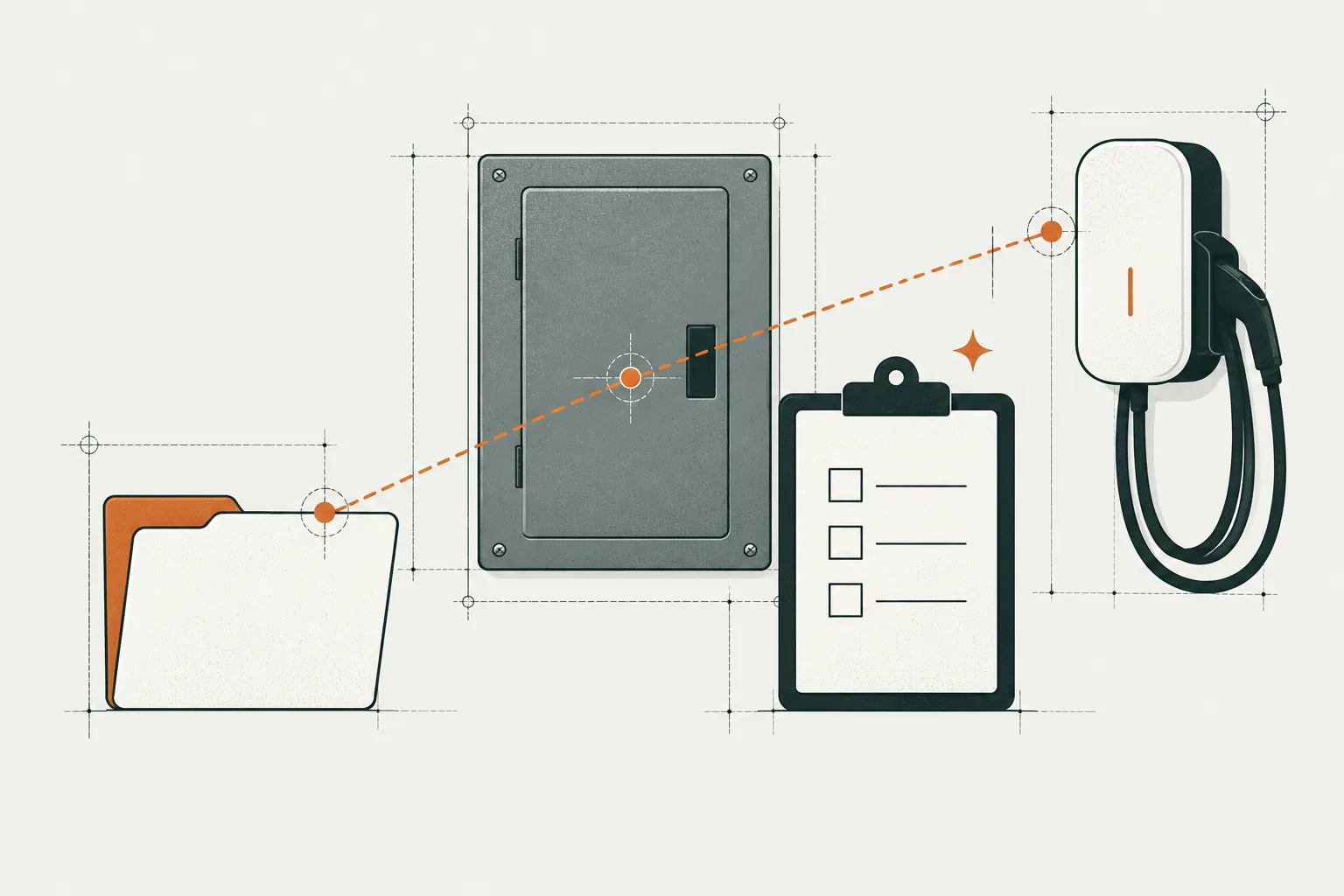
There is no single nationwide EV charger permit. The authority having jurisdiction—usually a city, county, state agency, or other local authority—decides which permit, plan, license, inspection, and adopted code apply. A new residential Level 2 circuit commonly requires an electrical permit, but the correct answer must come from the jurisdiction for the installation address.
Commercial and shared-property projects can add planning, zoning, accessibility, fire, civil, right-of-way, utility, or network requirements. The goal is not to collect every possible permit; it is to establish the real approval path before equipment is ordered or surfaces are opened.
Start with the authority, address, and project scope
Give the permitting office a precise description:
- property address and use;
- home, multifamily, workplace, fleet, or public charging;
- charger quantity and Level 1, Level 2, or DC charging type;
- hardwired or manufacturer-supported plug-in connection;
- proposed circuit and charging current;
- indoor, outdoor, garage, carport, or parking-lot location;
- panel/service work, trenching, new pedestal, or utility upgrade;
- whether charging is private, shared, paid, or publicly accessible.
The AFDC maintains a permitting-process resource with examples from multiple states and municipalities. Use it to understand common workflows, not as proof of your local requirements.
Residential projects often center on an electrical permit
A typical home Level 2 project may require an application, equipment information, circuit/load information, permit fee, and final inspection. Some jurisdictions offer streamlined online permits for standard installations; others require a contractor submission or plan review.
The permit does not replace design. Before filing, the electrician may need to establish service and panel capacity, circuit rating, conductor and wiring method, connection type, route, protection, charger listing, environmental suitability, and equipment instructions.
Do not rely on “the neighbor did not need one.” Boundaries, adopted code editions, local amendments, service conditions, and project scope differ.
A clear submittal reduces avoidable review cycles
Ask the installer which documents the jurisdiction expects. Depending on scope, that may include:
- permit application and contractor/license information;
- charger manufacturer, model, listing, and installation instructions;
- panel and service information;
- load calculation or approved energy-management design;
- circuit rating and configured charger output;
- simple site or floor plan showing equipment and parking;
- mounting, impact-protection, and weather-exposure details;
- utility authorization where service equipment changes;
- accessibility/site-plan details for shared or public use.
The installer should not submit a generic product sheet that conflicts with the exact model or proposed current.
Inspection is a project milestone, not paperwork afterthought
Confirm who schedules inspection, when the charger may be energized, and what must remain visible. Closing walls, backfilling trenches, or covering work before a required inspection can force rework.
At closeout, keep:
- permit number and approved documents;
- inspection approval or correction notice;
- charger model and serial number;
- configured output and circuit/breaker label;
- load-management settings where used;
- commissioning record, warranty, and installer invoice;
- photos of concealed routes before closure when appropriate.
Those records help with warranty support, future equipment changes, insurance questions, and property transfer.
Utility approval is separate from the building permit
The electrical inspector does not control utility service work. A project may need utility review for a new or larger service, transformer capacity, meter changes, managed charging, special rates, or commercial demand.
Contact the utility early when the design includes substantial new load, service equipment changes, multiple ports, DC fast charging, or an incentive with preapproval rules. A permit approval does not guarantee utility construction timing.
The AFDC's EV readiness guidance also advises communities and projects to involve the serving utility in site-level evaluation of available power and required upgrades.
Commercial sites can trigger more reviews
Commercial and public projects may require site-plan or zoning review, accessible design, civil work, drainage, lighting, signage, fire access, parking changes, and utility coordination. The U.S. Access Board's EV charging design recommendations explain accessibility considerations, while local rules determine enforceable requirements.
Accessibility is not solved by marking one standard stall. Reach range, clear floor space, operable parts, cable handling, route slope, curb transitions, payment/interface access, and connection position all affect usability.
Questions to put in the quote
- Which authority and permit type govern this address?
- Who prepares and submits each document?
- Are permit fees and corrections included?
- Is a load calculation or engineered document included?
- Who coordinates utility work?
- What must remain exposed for inspection?
- Who attends inspection and resolves corrections?
- When will the project be considered closed?
- Which records will the owner receive?
Use the installer comparison guide to normalize bids around these responsibilities.
Red flags
- “EV chargers never need permits.”
- A bid that omits permit and inspection responsibility.
- A contractor asking the owner to misdescribe the work.
- Equipment ordered before capacity and approval review.
- Commercial plans that ignore accessible routes or utility lead time.
- Final payment requested without inspection/closeout records where approval is required.
Do I need a permit to install an EV charger in Washington?
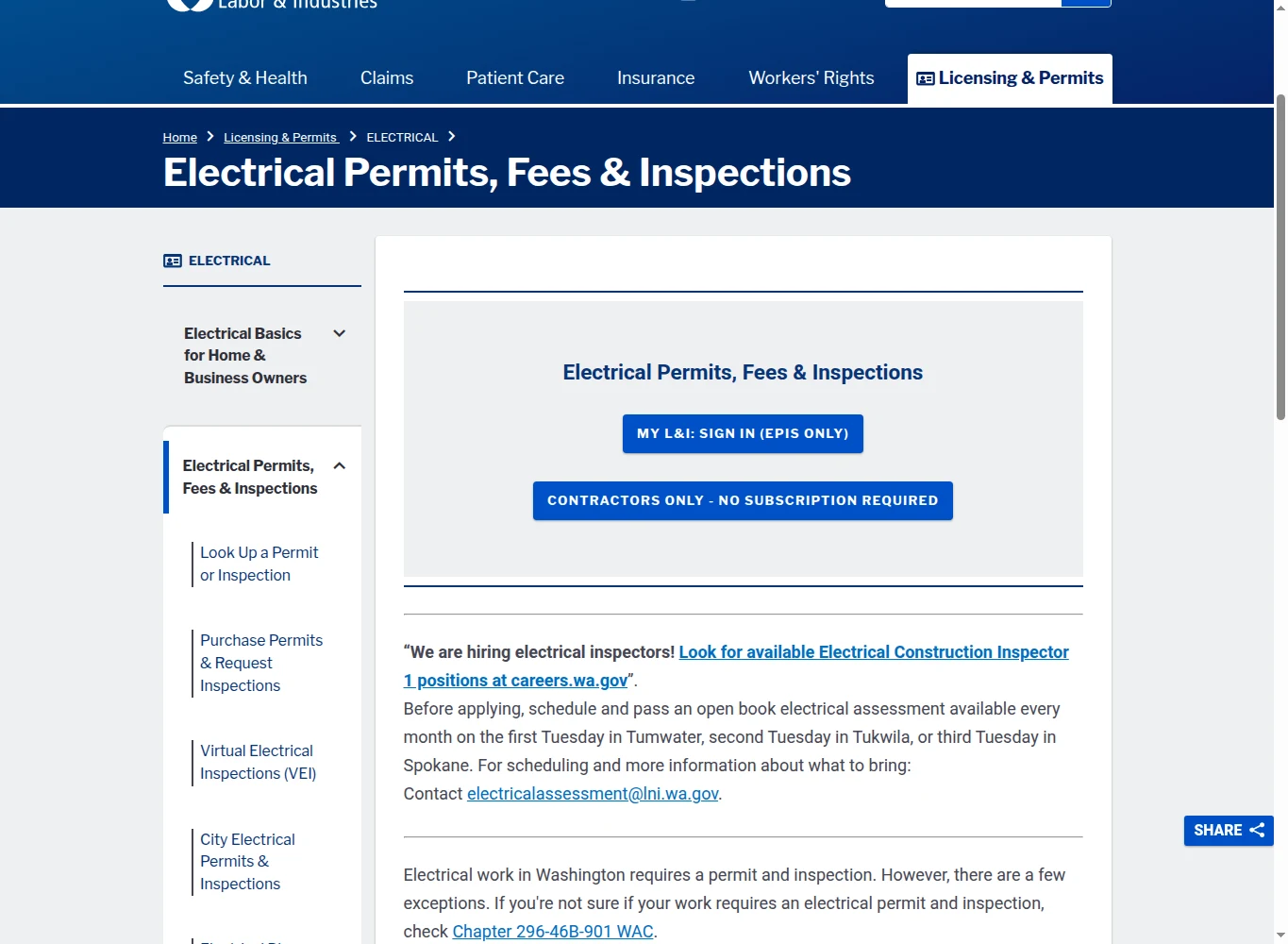
For a Washington project, start with the installation address and the actual electrical work, then identify the correct permitting authority. Washington Labor & Industries states that electrical work requires a permit and inspection, with exceptions. That general statement is a reason to check the project, not a determination that every existing plug-in situation follows the same process.
L&I's page separates its jurisdiction from cities that issue their own electrical permits and inspections, and from Tacoma Power's service area. Use the official jurisdiction links for your address before applying. The city name in a mailing address alone is not a complete project review, and a statewide article cannot issue an approval for the site.
If you hire an electrical contractor, L&I says that contractor must purchase its own permits for the work it performs on your property. Put that responsibility in the written quote, together with inspection scheduling, any required correction and the final record you will receive. Do not describe contractor-performed work as owner-performed work merely to obtain a different permit route.
As an example, a homeowner requesting a new Level 2 circuit can ask: “Which authority handles this address, which permit covers the proposed circuit and any panel work, and is your business obtaining it?” If the answer is L&I, use its current application and inspection process. If the address is within a city or Tacoma Power jurisdiction identified by the official page, use that authority's process instead. The exact charger, configured current, route, capacity assessment and work scope still need to be supplied.
Keep separate rows for the permit being issued, the applicable inspection result and the installer's commissioning handoff. A receipt for the application or a charger that powers on does not establish that all required approvals are complete. Where service equipment or the utility connection changes, obtain the utility's requirements as a separate dependency. Property or HOA permission is separate again.
For a quote that leaves those responsibilities blank, use the installer comparison checklist before committing. The Washington example shows how to identify and document the actual authority; readers elsewhere should follow the equivalent current state and local sources rather than importing Washington's process.
Confirm locally before work begins
Permit rules change and this guide is not legal or code advice. Verify the current process with the authority having jurisdiction, utility, property owner/association, and appropriately licensed professionals. Build the permit, inspection, and utility milestones into the project schedule rather than treating them as surprises.
For the full sequence, continue to the home EV charger installation guide or review commercial versus residential installation.
Washington permit checklist before installation
Use the authority decision above to prepare a short project worksheet. The purpose is to give the contractor and permit office enough information to identify the actual work, rather than asking a general question with no address or equipment scope.
Prepare the details for a useful answer
- Record the installation address and the proposed parking location.
- Identify a single-family home, rental site or shared parking arrangement.
- Name the proposed charger, connection method and professionally accepted current.
- Describe any new circuit, panel work, trenching or route through common areas.
- List the property owner or association whose permission may be needed.
For Seattle, the official EV charging installation tip provides a local project starting point. Its older examples do not replace today's code or a determination for your property. Confirm the actual requirements with the responsible office before relying on a specific example.
Keep three approval records
| Record | Question to settle | Evidence to retain |
|---|---|---|
| Electrical permit | Which authority handles the work, and who applies and schedules inspection? | Permit number and required inspection closeout |
| Utility dependency | Does the accepted design require service or utility work? | Utility response and any agreed prerequisite |
| Property permission | Who controls the parking space, route and common areas? | Applicable owner or association decision |
Fill this record from the actual proposal and authority, rather than another homeowner's permit fee or timeline. Use the installer comparison checklist when a bid leaves responsibility or closeout unclear.
Check how an existing-outlet proposal is classified
Plugging a listed portable unit into an existing suitable receptacle is different from installing a new outlet or altering the circuit. The general exceptions for plug-in appliances do not establish that an old garage receptacle, its wiring or the proposed charging load is appropriate. Ask the authority and qualified electrician how the exact work is classified before treating it as permit-free.
Keep the final permit and inspection record with the charger manual and accepted settings. The manufacturer's maximum output is not the household's approved allocation, and an application receipt is not proof that the installation has passed its required checks.