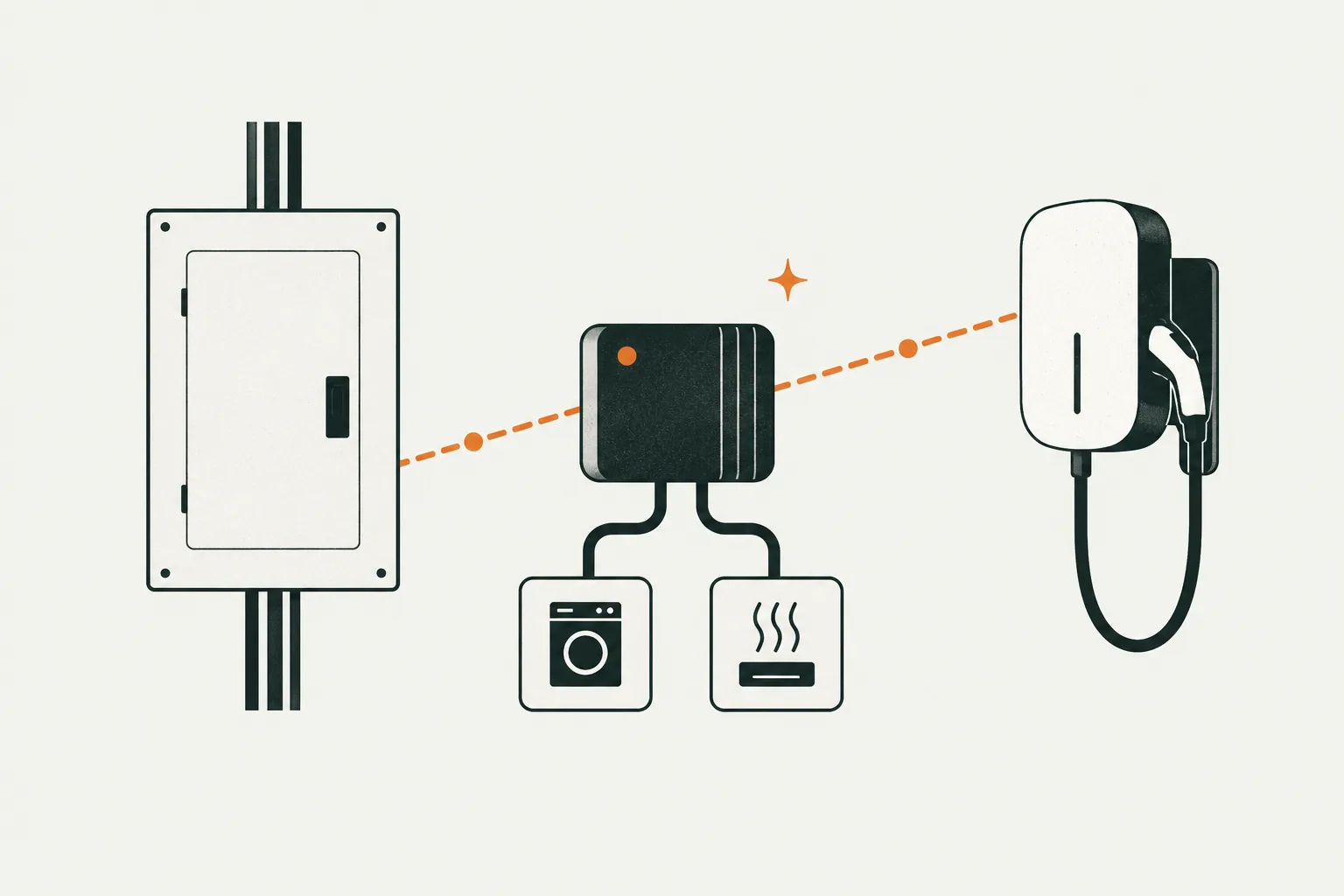
EV charging load management controls when or how much charging power is delivered so vehicles, a building, and the electrical service operate within a defined limit. It can be as simple as dividing a fixed site allowance among chargers or as responsive as measuring building demand and reducing EV load when other equipment is running.
It is not a universal panel-upgrade waiver. The equipment, design, monitoring method, fail-safe behavior, configuration, listing, adopted code, utility program, and authority acceptance all matter.
Three different ideas are often called load management
| Approach | What it controls | Typical use |
|---|---|---|
| Scheduled charging | Time, usually through vehicle or charger | Shift home charging to off-peak hours |
| Static power sharing | Fixed aggregate charger limit | Share a known capacity among multiple ports |
| Dynamic site management | EV load in response to measured building/site demand | Add charging without exceeding an approved site limit |
Scheduled charging can reduce cost or coincidence but does not, by itself, prove capacity. Static sharing prevents chargers from exceeding a set aggregate allocation. Dynamic management needs a reliable measurement/control path and defined response if communication fails.
Why sites use it
The Department of Energy describes smart charge management as coordinated control that can reduce upgrade needs, avoid peak costs, and still deliver the energy vehicles require. The same principles can apply at homes, multifamily properties, workplaces, and fleets at different scales.
Common goals include:
- fit one charger within a capacity-constrained home;
- share a circuit or site allocation across two or more approved chargers;
- reduce simultaneous charging peaks;
- coordinate charging with building demand or a utility rate;
- phase a multifamily or fleet deployment;
- preserve a documented minimum charge by departure.
Home dynamic management
A home system may measure service or feeder demand and adjust an EV charger's current so total load stays under a configured limit. That can be an alternative to some service or panel work when the exact system is approved for the application.
The design should document:
- measured point and sensors;
- controlled charger/model and supported current range;
- service, feeder, and circuit limits;
- communication method;
- minimum charging behavior;
- response to sensor, network, controller, or cloud failure;
- commissioning test and locked settings;
- who may change configuration later.
Do not accept “smart charger” as proof. Scheduling, app control, demand response, and code-recognized energy management are different capabilities.
Multiple chargers need an energy target, not equal amperage
At a two-EV home or shared site, dividing current equally is easy but not always useful. One vehicle may leave early; another may already be nearly full. A managed system can allocate energy by dwell window, state where available, user priority, or minimum service level.
For multifamily and commercial use, define fairness and failure behavior before vendor selection. Residents or fleet operators need to know what charging service is promised when every vehicle is connected.
The DOE's implementation guidance emphasizes coordination among vehicle operations, facility infrastructure, energy management, IT/cybersecurity, and the utility. A network subscription alone does not provide that governance.
Load management can affect the quote in both directions
It may avoid or defer expensive service, transformer, panel, or feeder work. It may also add controllers, meters, current sensors, network gateways, engineering, commissioning, subscriptions, cybersecurity review, and maintenance.
Compare complete alternatives:
- lower fixed charger current;
- static sharing;
- dynamic management;
- panel/feeder/service upgrade;
- a phased combination.
Use panel upgrade versus load management and request each bidder's capacity basis.
For commercial buildings, DOE's charging-integration guide explains why building demand, metering, rates, and supervisory control should be considered together.
Failure modes belong in the design
Ask what happens when:
- current sensors are reversed, disconnected, or stop reporting;
- local Wi-Fi or internet fails;
- cloud service is unavailable;
- a charger is replaced;
- firmware updates change behavior;
- the controller loses power;
- someone changes the breaker/current setting;
- another major load is added to the building.
The safe response may be reduced charging, paused charging, a fixed fallback, or a fault—depending on the listed system and design. “It should reconnect” is not a commissioning plan.
Commissioning checklist
The qualified installer should carry out the applicable tests below under the exact manufacturer procedure and accepted design. They are not instructions for an owner to create a high-load or communications-loss fault.
- Confirm installed model numbers and compatible firmware.
- Verify sensor placement/orientation and measured values.
- Confirm breaker, circuit, service, and charger settings.
- Simulate high building load and observe the EV response.
- Test the documented communication-loss behavior.
- Label controlled equipment and restricted settings.
- Save configuration, one-line/site documentation, and support contacts.
- Give the owner a procedure for future electrical changes.
Utility-managed charging is related but different
A utility program may shift or reduce charging based on rates, grid events, or enrollment terms. It can save money or earn an incentive, but the program's remote control is not automatically the local electrical capacity control used by the site design.
Confirm whether the utility program, charger schedule, and site controller can conflict. Read data-sharing, opt-out, override, and unenrollment rules.
Signs a proposal is incomplete
- It promises “no panel upgrade” before a capacity assessment.
- It does not name the controller, charger, sensors, or listing.
- It requires the cloud but has no outage behavior.
- It shares power without a minimum service target.
- No one owns commissioning or configuration records.
- The installer cannot explain local approval.
Give the installer a whole-system acceptance record
Record what the system measures, what it controls and what limit it protects. “Two chargers share power” does not establish that the total building demand is being measured. Likewise, a vehicle schedule can move charging to a different time without providing the protective control used in the accepted electrical design.
A useful record has separate fields for the measurement location; sensor/controller and charger models; supported software or firmware; service, feeder and branch limits; authorized administrator; expected offline response; and professional commissioning evidence. Ask the designer which components are necessary and which features are merely convenient. Keep that answer beside the exact manuals.
An illustrative household might have enough overnight energy capacity for two drivers, yet fail because both cars depart early and cannot be moved between spaces. Solve that two-driver timetable before assuming equal power is an adequate service. At a shared property, record what each eligible driver should receive when demand is high, who communicates an outage and who can change the allocation.
Product-specific controls require their own checks. Emporia PowerSmart and Emporia multiple-charger Load Sharing perform different jobs; exact component, version and installation requirements belong in the corresponding method. Household administration and restricted-driver access are separate permission decisions. A feature name does not establish suitability for billing or a particular shared circuit.
When the design calls for communication-loss or high-load demonstrations, have the qualified installer perform the manufacturer-supported tests. Owners should not disconnect sensors, overload circuits or alter protective settings to see what happens. Retain the expected result, actual professional observation and unresolved correction. Review the record after equipment replacement, administrator changes, major new loads or an update that affects control behavior.
Treat control as electrical infrastructure
Load management can be a strong solution when its limit, measurement, communication, failure state, and operating outcome are explicit. It should make the capacity case more defensible—not hide it behind an app.
For installation scoping, continue to the home EV charger installation guide or multifamily planning guide.