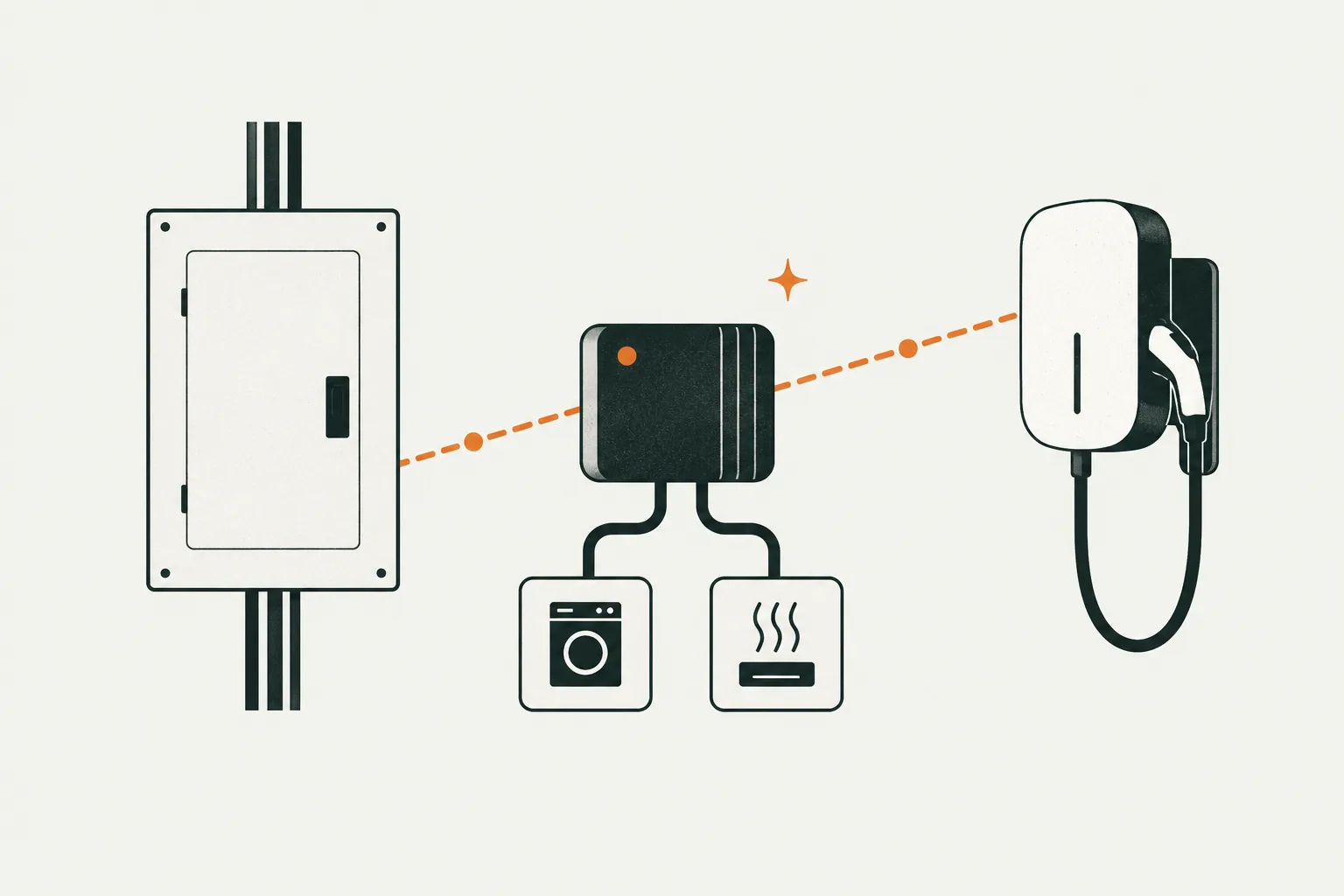
Start a two-EV charging plan with both drivers' next departures, then work backward to the energy and parking time available. The number of cars alone does not tell you how many chargers to buy.
One existing charger can be enough when the household has adequate energy delivery and a workable routine. A different arrangement may be worthwhile when departures overlap, cars cannot be moved, connectors differ or convenience matters enough to justify the complete installed cost. Those are distinct questions from whether the electrical service can support additional equipment.
Make a small record for each vehicle
For a normal week, write down daily driving, approximate energy use, arrival time and next required departure. Add a demanding week: a longer commute, an evening journey or an early start. Use the vehicle's own information where possible and keep seasonal variation visible.
Also record the connector, the vehicle's supported AC charging limit and the existing charger's approved configuration. A more powerful wall unit cannot make a vehicle accept power beyond its own capability. Different connectors may also require a supported equipment or manufacturer-approved adapter choice; do not assume every adapter works in every direction.
The EPA home-charger calculator is a useful starting point for an individual vehicle's mileage and available charging hours. The household task then adds the interactions between two cars.
| Vehicle detail | Driver A | Driver B |
|---|---|---|
| Energy needed before next departure | Your estimate | Your estimate |
| Earliest practical plug-in | Actual time | Actual time |
| Required departure | Actual time | Actual time |
| Parking and cable reach | Where it parks | Where it parks |
| Ability to move the car | Who and when | Who and when |
| Connector and supported charging | Verified model details | Verified model details |
Keep personal schedules within the household. You can share a simplified charging need with an installer without giving them unnecessary information about when the home is empty.
Separate energy from the physical routine
Suppose one car needs 18 kWh and the other needs 10 kWh before morning. At an assumed effective delivery rate of 6 kW, their combined 28 kWh requires about 4.7 charging hours, before extra time or energy margin.
That arithmetic is an illustrative planning example, not a measured charging result or circuit design. It also leaves out the practical question: can the household actually give each car its required time?
If the first car uses the charger for three hours, someone may need to disconnect it, move a vehicle and connect the second. A household that sleeps through the proposed swap has not found a usable routine. If the driveway arrangement blocks the second car, having enough total hours does not solve access.
Mark each charging session on a timetable. Include the changeover itself rather than treating one long overnight block as automatically available to both vehicles.
Plan the order around deadlines
The car leaving first may need priority even when it drives fewer miles. One driver may also have a more reliable opportunity to charge at work, allowing household time to serve the other.
Build the schedule around the minimum useful result for each departure, within the vehicle manufacturer's charge guidance. There is no need to assume both cars must receive a full battery every night. Conversely, do not leave one driver's recurring need dependent on surplus time that exists only in the average week.
Try to reduce fragile changeovers. If one car regularly returns with enough energy for the next day, alternating longer sessions on different evenings may be easier than a nightly swap. That depends on the actual driving and reserve requirements, not on a universal alternating-day rule.
Test the demanding night and a disrupted week
Add the conditions most likely to expose a weak plan: both drivers arrive late, one leaves early, the preferred off-peak window is shorter, or a regular workplace opportunity is unavailable.
A useful test has a definite outcome. Can each vehicle meet its recorded next-departure need using permitted equipment and a movement routine the household can follow? If the answer relies on an unverified public station, check that option using the no-home charging routine method.
Keep the failure specific. “Not enough charging” may mean too little energy, incompatible access, an impractical swap or unwillingness to move cars. Different constraints justify different changes.
Keep tariff scheduling separate from electrical control
An off-peak schedule can reduce cost where the current tariff supports it. It does not ensure that simultaneous loads remain within the approved electrical design.
If both cars can charge through separate equipment, ask the qualified designer how total demand is limited and what happens if communications or a control component fails. A pair of apps that normally start at different times is not, by itself, an electrical-capacity protection scheme.
The EV load-management guide distinguishes scheduling, sharing and dynamic capacity control. Use that explanation before comparing product-specific features. The whole-household rate comparison helps check whether moving energy into a cheaper window actually improves the total bill.
Compare complete alternatives at the same result
Retain the existing arrangement if it meets the household's needs at acceptable effort. If it does not, compare alternatives against the same two-driver timetable:
- a revised routine using the present approved installation;
- another suitable, professionally assessed charging point;
- a supported multi-charger sharing or management arrangement;
- different permitted charging access for one vehicle;
- electrical upgrades where the professional assessment establishes a need.
Each proposal should explain the delivered service, total installed scope, necessary controls, ongoing fees and behavior when both cars request energy. Two chargers on the wall do not necessarily provide two independent maximum-power sessions.
The panel-upgrade decision guide helps separate panel space, equipment condition, calculated load and utility-service constraints. Do not buy a splitter or add a circuit based only on the timetable's energy calculation.
Give the installer the shortfall, not a shopping demand
Bring the two-car worksheet, current equipment identity, parking arrangement and the nights that fail. Describe the desired outcome clearly: for example, both cars need their recorded replenishment by 6 a.m., and nobody can move a vehicle after 10 p.m.
Ask the installer to compare feasible options and record the approved limit and required components. Where an exact product has a separate multi-unit or management feature, confirm its supported versions and installation requirements rather than assuming that a family name or subscription supplies compatibility.
Use the installer and quote checklist to compare complete scopes. Keep device setup and user permissions in the handover so that an extra household member does not accidentally receive broader access than intended.
Confirm the plan with ordinary use
After the installation is accepted, observe a demanding but normal charging night. Check actual energy delivery, departure readiness, access and the effort of the routine. Keep any electrical or protective-function tests with the qualified professional.
Record what changed if the result differs from the plan. A vehicle setting, a schedule conflict or a shared-power allocation may explain the difference; increasing current without an approved basis is not the remedy.
The DOE home-charging resource provides the wider Level 1 and Level 2 context. The right household arrangement is the smallest complete, approved system that reliably serves both drivers, with a routine they can sustain.